
Why this is a workflow problem, not a knowledge problem
The instinct is to assume self-represented parents fail because they do not know the law. Sometimes. But far more often, the system is technically accessible and still operationally crushing. California's courts openly provide free family-law self-help at every superior court. The statewide self-help system offers pathways for divorce, custody, support, and requests for orders. Orange County runs a dedicated Self-Help Portal with workshops and document review. LAFLA operates self-help centers and a hotline for divorce, custody, support, paternity, and restraining orders.
So the information and the official touchpoints are there. What is missing is the connective tissue: the help organizing your situation before you walk into a self-help center, choosing which forms actually apply to your circumstances, turning a messy life situation into a coherent declaration, tracking deadlines and service requirements, and preparing for mediation intake. That is a workflow problem. And workflow problems are exactly what Mansa Merch builds systems to solve.
A self-represented parent does not need someone to invent a legal process. They need help navigating the procedural burden before, between, and around the official touchpoints that already exist.
The blueprint: from confusion to a prepared packet
Rather than claim a customer deployment that does not yet exist at scale, this case study maps the actual workflow Mainstay is built to support: how a parent or guardian moves from confusion to a prepared, organized packet and a clean sequence of next steps, using official California processes.
Stage 1: Starting from nothing
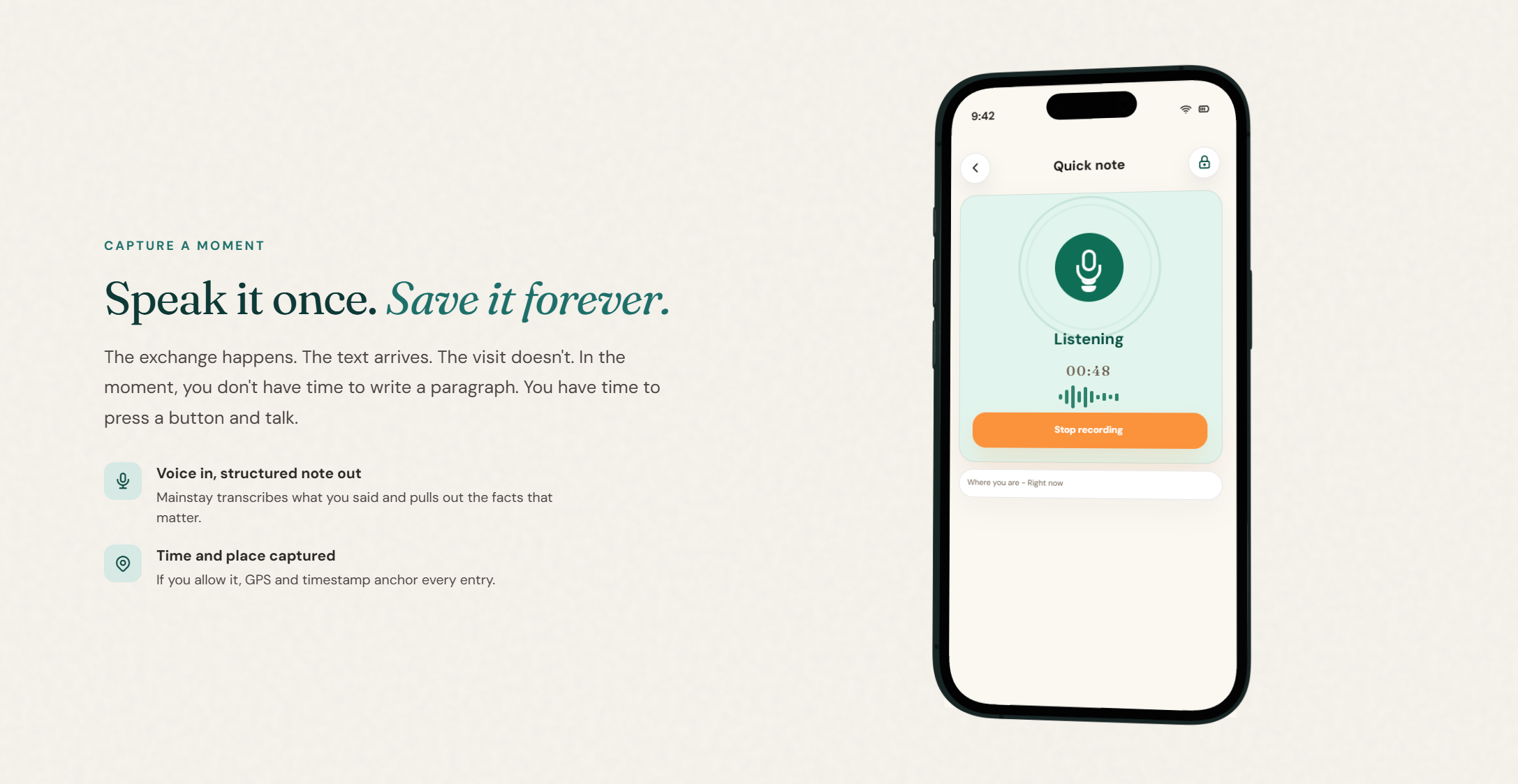
The hardest and most expensive moment is the blank page. A parent knows their situation but has no idea where to begin. This is where many people either freeze or pay an attorney hundreds of dollars an hour simply to get oriented. Mainstay gives a starting point: the user describes their situation in plain language (typed or as a voice memo), and the app helps translate that into a structured first draft of a declaration, a coherent narrative of facts in the user's own words.
Stage 2: Understanding what applies to you
If the user already has a declaration, Mainstay parses it with an agentic workflow, highlights the key elements, and helps the user understand which forms might correspond to their situation and the context they want to share. This is the orientation step that is otherwise the most expensive part of getting started: not the filing itself, but figuring out what to file.
Mainstay is explicit about its boundary here. It provides legal information and document organization, not legal advice. It helps the user understand their own situation and the procedural landscape so they can make informed decisions, the same posture California's own self-help facilitators take when they note they are not the litigant's attorney.
Stage 3: Building the packet
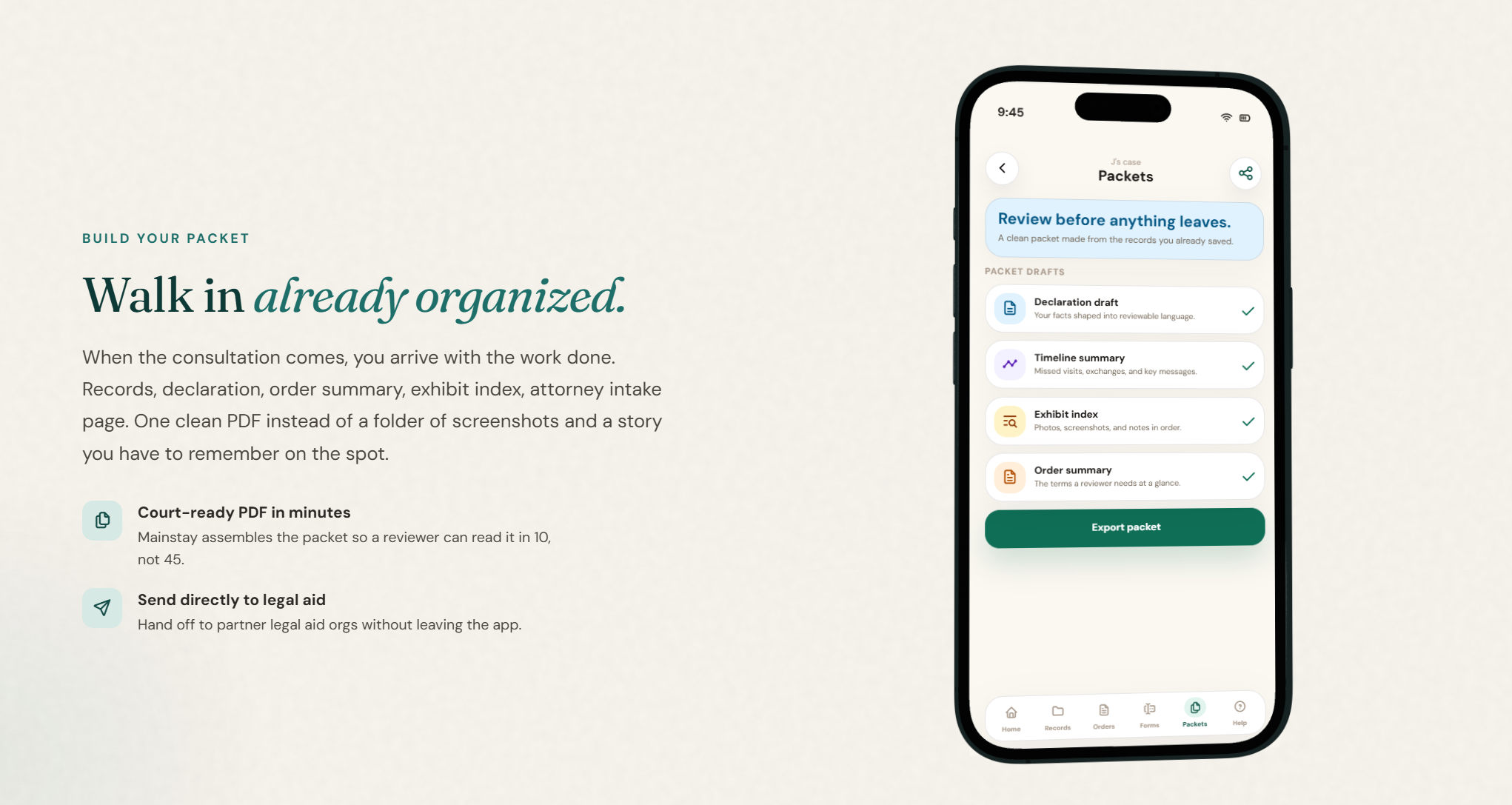
Mainstay helps assemble a downloadable packet: organized declarations, the relevant forms identified, and a coherent sequence. The user walks away with something concrete and grounded, rather than a pile of disconnected PDFs and a vague sense of dread.
Stage 4: Choosing the path forward
Crucially, Mainstay does not trap the user. With an organized packet in hand, they can choose their path: file on their own through a self-help center, take it to a pro bono clinic, or hire an attorney for a more efficient (and cheaper) engagement because the groundwork is done. Mainstay also includes a resource directory to help users find legal aid and pro bono support, plus emergency resources for those in genuinely urgent or unsafe situations. The goal is never to replace those services. It is to expedite the help a person needs and let them arrive prepared.
Mainstay is built for two audiences. For self-represented parents, it is procedural clarity under stress. For legal aid organizations, courts, and nonprofits, it is a force multiplier: clients who arrive with organized packets and clear questions consume far less of a limited pro bono capacity, and intake becomes dramatically more efficient. If your organization is interested in partnering, white-labeling, or commissioning a tailored build for your service population, that is a conversation we want to have. The same execution discipline that built Mainstay can be directed at your workflow.
California family court is technically accessible but operationally overwhelming. The official self-help infrastructure exists, yet the burden of organizing facts, choosing forms, drafting declarations, preparing for mediation, and holding it all together still lands on people under emotional and financial strain. Mainstay lives in that gap as procedural workflow support, not legal advice: it helps a user move from a blank page to an organized packet and a clear set of options. For parents, that is confidence and clarity. For legal aid organizations, it is a way to stretch limited capacity further. The opportunity is real precisely because the system is open but hard to navigate, and that navigation is a workflow problem we know how to solve.
Why Mansa Merch is building this
Across our work, the throughline is structure where things are messy and high-stakes. We built export infrastructure where none existed, verification where trust was missing, and disciplined execution where deals were time-constrained and fragmented. Family court self-help is the same kind of problem wearing different clothes: a person with a real situation, a system that is technically open, and a painful gap in between. Mainstay is our answer to that gap, built with the seriousness the subject deserves and explicit guardrails around the line between information and advice.